Aug 20, 2013

Wachau & Kamptal trip (Austria) - Part 2 - F.X. Pichler visit


F.X. Pichler is not only the most renowned winery in Wachau but all of Austria, and a must-go site when visiting the Wachau valley. The winery is located in Dürnstein (Oberloiben 57, 3601 Dürnstein; http://www.fx-pichler.at), surrounded by the Klostersatz vineyard and overlooking the famous Kellerberg, Schütt and Loibenberg wine terraces. The modern building is a piece of art itself, and so are the wines made and deposited within the premises.

F.X. Pichler produces only white wines from Grüner Veltliner, Riesling and Sauvignon blanc grapes, of which classifications are roughly 80% smaragd and 20% federspiel, a ratio which is unrivaled in Wachau and speaks volumes on behalf of their vineyards potential for ripening grapes. The amounts produced are small, 130,000 bottles per year, thus prices tend to be high for these sought-after wines.

Lucas Pichler took over vinification in 1999 from Franz Xaver (hence, F.X.) to continue the long winemaking tradition of the estate which started in 1898. Franz Xaver had run the estate for 28 years, from 1971, including the period in early 1990s when the estate became world known and releasing the first "M" and "Unendlich" wines. Unfortunately, we were not able to taste these monumental wines during our visit.

Harvest is done usually on the first week of October with a small team of only +/- 15 people, i.e. the vineyard team and certain experienced extras. The amount of workers needed is small as different grape varieties ripen at different points of time, thus enabling the same team to harvest all the vineyards. It represents a very drastic difference compared to harvests in Burgundy's Gevrey-Chambertin for example, where we used some 40 people to harvest a little over 12 hectares in 9 days. In most of Burgundy, only two grape varieties, pinot noir and chardonnay, are cultivated and they are picked up entirely when the grapes show the desired ripeness. In Wachau, the harvest period is significantly longer due to differences in ripening of the grapes.

F.X. Pichler's vineyard team knows each grapevine individually and thus is able to make selection on the vineyard very efficiently, enabling good organization of harvest. There is a very thorough selection made on the vineyard with the team going through the same row of vines up to 3 or 4 times in order to be able to pick the ripened grapes.

Wines are fermented in stainless steel and matured in used, 30-40 years old large oak sourced from north of the Wachau valley. No 225 litre barriques are allowed for wines registered under Wachau's official classification (i.e. Steinfeder, Federspiel, Smaragd, in increasing order acccording to minimum must weight & potential alcohol content).
  
The "M" wines, which are F.X. Pichler's most well known wines internationally (made from Grüner Vetliner and Riesling), of which name M stands for "Monumental", the wine style is that of a big wine. The grapes are mostly (80%) harvested from the Loibenberg cru with the end product being a mix of the most potential single vineyard grapes left unharvested by the team for a couple more weeks after harvesting of the single vineyards. The grapes achieve higher sugar level and ripeness, thus producing a big and poweful wine with long cellaring potential. The soil composition is loess and primary rock, mostly gneiss, which gives minerality to the wines. The south facing vineyard has significant sun exposure which facilitates ripening of the grapes.

The "FX" sign in the picture indicates the location of the winery, arrows indicating the vineyard of Loibenberg
(picture from F.X. Pichler's website) 

Kellerberg, on the other hand, is somewhat cooler than Loibenberg as it enjoys a northern wind blowing through the small valley between Kellerberg and Loibenberg (in the above picture, the small valley can be seen immediately to the left of the first white arrow).

While Loibenberg is sometimes called the "oven" of Dürnstein, Kellerberg's milder microclimate with the cooling air breeze, exposure to south/south-east, and somewhat similar soil composition of primitive rock with loess deposits gives the wine the basis on which powerful but better structured (as in acidity structure) wines develop. Kellerberg is F.X. Pichler's most important single cru.

Arrows indicate the vineyard of Kellerberg
(picture from F.X. Pichler's website) 


The Klostersatz vineyard is situated on the flat (in the front), with Kellerberg vineyard in the back of the photo on the terraces.  Kellerberg is F.X. Pichler's most important single vineyard, facing south / southeast, in Dürnstein, Wachau.


The Loibenberg terraces in Wachau, from where 80% of grapes for the "M"-wines are harvested. In the picture, Hochstrasser vineyard  is situated on the flat at the base of Loibenberg.

The Loibenberg vineyard continues to the east on a south facing slope

Tasting 

We were met at the estate by Johanna Pichler, wife of chief winemaker Lucas Pichler. There were only four wines offered for tasting at the winery, and our brief remarks on the tasted wines are below. The most interesting quality is the wines' ability to age - see my earlier notes on the 2006 Grüner Veltliner Smaragd Von den Terrassen from here - as the 2006 was best of F.X. Pichler's wines tasted during the trip. Their best wines achieve long age in the bottle, and the seven-year-old GV smaragd mentioned above had already developed nicely, giving framework for GV smaragds harvested from the terraces to be enjoyed after minimum of 5 years from vintage.


F.X. Pichler Grüner Veltliner Federspiel Loibner Klostersatz 2011 (12.5% abv.)

Started the tasting with Austria's, and especially Wachau's, "own" grape, the grüner veltliner. Made from grapes grown on the flat area just next to the winery (i.e. not from the terraces), this grüner veltliner is the lightest of the wines tasted, still offering good structure with a soft but slightly crisp feeling (only 1 g/litre of residual sugar in this young wine). Keep for 4-5 years, then enjoy.

F.X. Pichler Grüner Veltliner Smaragd Urgestein Terrassen 2011 (13.5% abv.)

Harvested from several vineyards situated on the terraces, the wine is made as a mix of Loibenberg, Kellerberg, Steinertal and Mühlpoint grapes. Beautiful young wine with more oomph than the Klostersatz, ready to be drank from 2016 onwards. The wine has more extraction from grape than the lighter Klostersatz, and with 2.5g/l residual sugar, a somewhat rounder mouth feel. Better vineyard position on the terraces gives more structural components to the wine. Acidity levels have been very good in both of the grüners thus far.

F.X. Pichler Riesling Smaragd Oberhauser 2012 (13.0% abv.)

A fresh and youthful wine with defined concentration of aromas, the Riesling Oberhauser 2012 is a more round on the palate compared to earlier wines, explained by 4g/l of residual sugar in it. Cinnamon, citrus and baked apple cake with a smokey feeling, and very nice acidity which carries the aftertaste far.


F.X. Pichler Grüner Veltliner Smaragd Dürnsteiner Liebenberg 2011 (14.0% abv.)

The wine is round and silky however with a high alcohol content which slightly overpowers the otherwise beautifully structured wine. It seems to be the case with many smaragd wines (not only Pichler's), the other components have to match the high alcohol content of the smaragds for the wine to feel as balanced - here the balance is slightly on the alcohol side. The vineyard is pictured below - it is situated to the east from Dürnstein on the turn of the Donau river before the town, i.e. actually closer to the town of Weissenkirchen, on the south/southwest facing terraces. 

The Liebenberg vineyard is situated on the terraces before the turn of river Donau (on the slopes to the left in the picture), behind the flat area which is the "Frauengärten" vineyard.  


Aug 19, 2013

Wachau & Kamptal trip (Austria) - Part 1 - F.X. Pichler Grüner Veltliner Von den Terrassen Smaragd 2006


F.X. Pichler's 2006 Grüner Veltliner Smaragd Von den Terrassen was one of the most memorable wines during my trip to Austria this July. Found this gem in the Wine & Co shop in Vienna for only 29 eur, which is remarkable since the new vintages were priced on the same level, 2006 being an excellent vintage for grüner veltliner in Wachau, and older vintages were hard to come by.

The color is already slightly developed straw yellow with a reflection to greenish. The wine's age of 7 years is evident on the nose which is already developed and pronounced. The wine has smoke, caramelized pear, ripe apple and vanilla notes on the nose with a hint of minerality.

The smoky notes on the nose remind me of a smoke sauna (a Nordic tradition), however the smokiness does not dominate. In fact, F.X. Pichler uses only large oak (no barriques are allowed under Wachau rules), thus neither oak or toasty notes dominate and their wines keep the natural freshness. Similarly reminding me of a smoke sauna, there was a hint of chemical substance on the nose.

On the palate, the wine triumphs over its so many peers. Elegant, broad and nicely structured, it has great acidity (I would rate 3+ or 4 on a scale of 5) which carries the beautiful taste long in the aftertaste. The secondary notes, which evolve through additional years in aging the wine, can be felt here and viscosity is slightly heavier than for younger grüners. Oak is present on the palate while the alcohol level (14% abv.) is a bit high overpowering the mouthfeel somewhat, however on a positive side it provides backbone for the wine.

The taste has a plethora of pear, apple and smoky notes, I actually wrote on my notes that the wine is wine world's equivalent to a strongly peated single malt whisky! Which could be a bit troubling to read for many wine lovers, however I still encourage to try this wine and you will see how elegant it can be.

More tasting notes to follow soon with winery visit information and recommendations.

Jul 8, 2013

Valpolicella Tour: Tedeschi


Tedeschi

During my visit to Valpolicella, Italy, this July I made it a priority to visit the Tedeschi estate in San Pietro di Cariano, 15 km from Verona. Tedeschi is family-owned and Sabrina Tedeschi herself met us in the morning and gave a tour in the cellar as well as wine tasting.

Sabrina Tedeschi at the wine cellar at San Pietro di Cariano
The Tedeschi family grew their business to larger export sales in the 1980s. Market reception of their wines has been positive as Tedeschi's wines seem to be very approachable in their youth due to their friendly, moderate tannin structure, and the style being fruit-driven. Only moderate tannin is extracted while at the same time fruit extraction is great. Looking at professional reviewers, most reviewers agree on the fruit-driven style however also praise the depth of the wines, which adds to the tasting experience. And the price-quality ratio seems one of the best in Valpolicella for the lower end of their range of wines.

As most consumers drink their wines young, Tedeschi has found a formula for success. Even their 2008 Amarone was already drinking surprisingly well at its youth, however you should not discount their maturation potential, as the amarones are worth cellaring for 10+ years. Big Slavonian oak is used for the amarones.

A few remarks on the most interesting wines below:

The flagship wine - Monte Olmi Amarone 

Tedeschi’s flagship wine, the Capitel Montel Olmi Amarone, is a single cru wine from grapes grown in a 2.5 ha vineyard on the Pedemonte hill in the heart of Valpolicella which the family purchased in 1918. The vineyard faces south-west and its soil is red clay and limestone. The density of wines is only 3,500 as the vineyard is built on terraces, thus reducing the annual production quantity. Interestingly, the wine is a blend of 9 grapes - 30% Corvina, 30% Corvinone, 30% Rondinella, and the rest 10% comprising Molinara, Rossignola, Oseleta, Negrara, Dindarella, Croatina and Forselina. Similar to the Amarone Classico, grapes are dried for 4 months and in January a slow alcoholic fermentation in temperature controlled tanks follows with temperatures as low as 15 celsius.

Given the low temperatures, the fermentation and maceration processes are very slow. The low temperature used in fermentation and maceration is traditional in amarone wine making, portraying the inside temperature in the winter time in Northern Italy in January/February. Slavonian oak barrels are used for maturation for 2-3 years.

The 2007 Monte Olmi had significantly more backbone from higher tannins and grip than the regular Amarone. It is up to the consumer to judge which style to prefer, however this one is made for longer cellaring and should reward the keeper in the long term. The Monte Olmi is a wine with such density and tannin that you should cellar these wines and drink the other Tedeschi wines in the meanwhile as the estate has a range for both short-term consumption and long-term cellaring.

The regular Amarone 2008

Tedeschi’s regular Amarone della Valpolicella is a good deal indeed for its price. Made of grapes grown on the Mezzane and Tregnano hills, the vines have an average age of 20 years and are planted 5,500 per hectare. The wine is a blend of 7 grapes - 30% Corvina, 30% Corvinone, 30% Rondinella, and the rest 10% comprising Rossignola, Oseleta, Negrara and Dindarella. Grapes are dried for 4 months after the October harvest in a humidity controlled facility, after which they are pressed softly. Alcoholic fermentation and maceration are done in a low 15 celsius temperature. Finally, the wine is aged in Slavonian oak.

2009 Corasco Appasimento Breva

From three different grapes, 70% Corvina (grown in Moraine Hills in Valpolicella), 20% Refosco (grown in Aquileia, Friuli) and 5% Raboso (grown in Oderzo, Treviso). The name of the wine comes from the three grapes used in making it, CORvina, RAbosa and refoSCO.

Made in the appassimento style, grapes were dried for only one month which is one fourth of the duration if making Amarones. During the appasimento process, the grapes lose one third of their weight as they dry, thus leaving a higher concentration of fruit and sugar, giving the otherwise fruity dry young wine a feeling of sweetness in the mouthfeel as well as depth.

Matured 1.5 years in big Slavonian oak. A very round wine with ripe fruit and raspberry, menthol, chocolate and spicy notes dominating. Also white pepper, vanillin and cherries. The addition of Refosco gives the wine a nice personality. Acidity is pleasant. A very good everyday wine. For some 13 euro a great buy. Will develop further, however enjoyable now.


Valpolicella Tour: Tommaso Bussola

Tommaso Bussola is one estate you shouldn't miss when travelling to the Valpolicella region.

The estate lies among the very top estates in quality its wines, made in artesan wine making style, and compared to the older and definitely more pricey estates of Quintarelli and Dal Forno, Tommaso Bussola's wines are low priced for the awesome quality they offer.

Tommaso Bussola's artesan wine making and wines are extraordinary, crafted by passionate people and in small quantities.

As producers like Tedeschi are believers in controlled wine making and state-of-the-art grape drying facilities, Tommaso Bussola believes in all natural wine making techniques where technological advances doe not play a role.

We were glad to meet Daniela at the estate who gave us a presentation on the wines. Her husband, Tommaso, is the man behind the operations with help of their son Paolo.

We tasted only the "TB" range at the estate.

I have to state that though Quintarelli and Dal Forno are world renowned masters in Amarone production, Tommasso Bussola ranks in my books with them, however with significant advantage in price you have to pay for a bottle since the before mentioned producers are definitely on the high end.

Especially their flagship Amarone (Vigneto Alto, tasted the 2006 vintage) is a true beauty, something to really look for and the best wine I had during the trip to Valpolicella. Artesan winemaking was very evident from the wines since they had  a special feeling to them. The wine spends 4 years in French oak. Really concentrated wine with such a ripeness of fruit that it is almost sweet on the mouthfeel -tobacco, espresso notes being very eminent. The best grapes are used for the Vigneto Alto.

It seems that using double barriques makes a difference in amarones, Tommaso Bussola uses them a lot.

Production is limited to 20,000 thousand for Amarones, 25,000 for Valpolicella Ca del Laito, and under 10,000 bottles per each of the rest of range.

The "Ca del Laito" 2008 is a Valpolicella Superiore which is very good in its own class. Recommended. Full bodied and with great tannin structure. Blueberries, chocolate and dark berries. The Valpolicella Classio 2007 offers more toasty and tobacco notes compared to "Ca del Laito".

Plus a really interesting IGT Rosso Veronese:

L'Errante 2007 (IGT Rosso Veronese)

My travel companion said that she has maybe never had a wine as great as the L'Errante 2007.

A red bordeaux blend (merlot 50%, cabernet sauvignon 25%, cabernet franc 25%) with limited production of only 8,000 bottles from a vineyard located in Negrar.

This extraordinary wine boasts aromas of espresso, chocolate, plum & blueberry & blackcurrant leaves mixed together in a highly concentrated package. It is very velvety, round and beautiful all the way to the lingering finish. Outstanding structure.

The wine is quite unique, albeit other producers try to experiment with similar grapes and winemaking style.
Made in amarone style, i.e. the grapes go through appasimento (grape drying). With a huge 16.5% abv, the wine is still miraculously in balance as the extraction of fruit is superb and the wine has sweet tannins. Both French oak and American oak was used (mostly French, and new), and my liking this wine is surprising since I am not a fan of American oak used in old-continent wines, however I still adored this wine.

With €40 you get a very good wine at a reasonable price. The wine is approachable now however will surely develop into a hedonistic piece of heaven with further maturation and should well last 10+ years. It is definitely worth trying now however rewards cellaring.


Apr 9, 2013

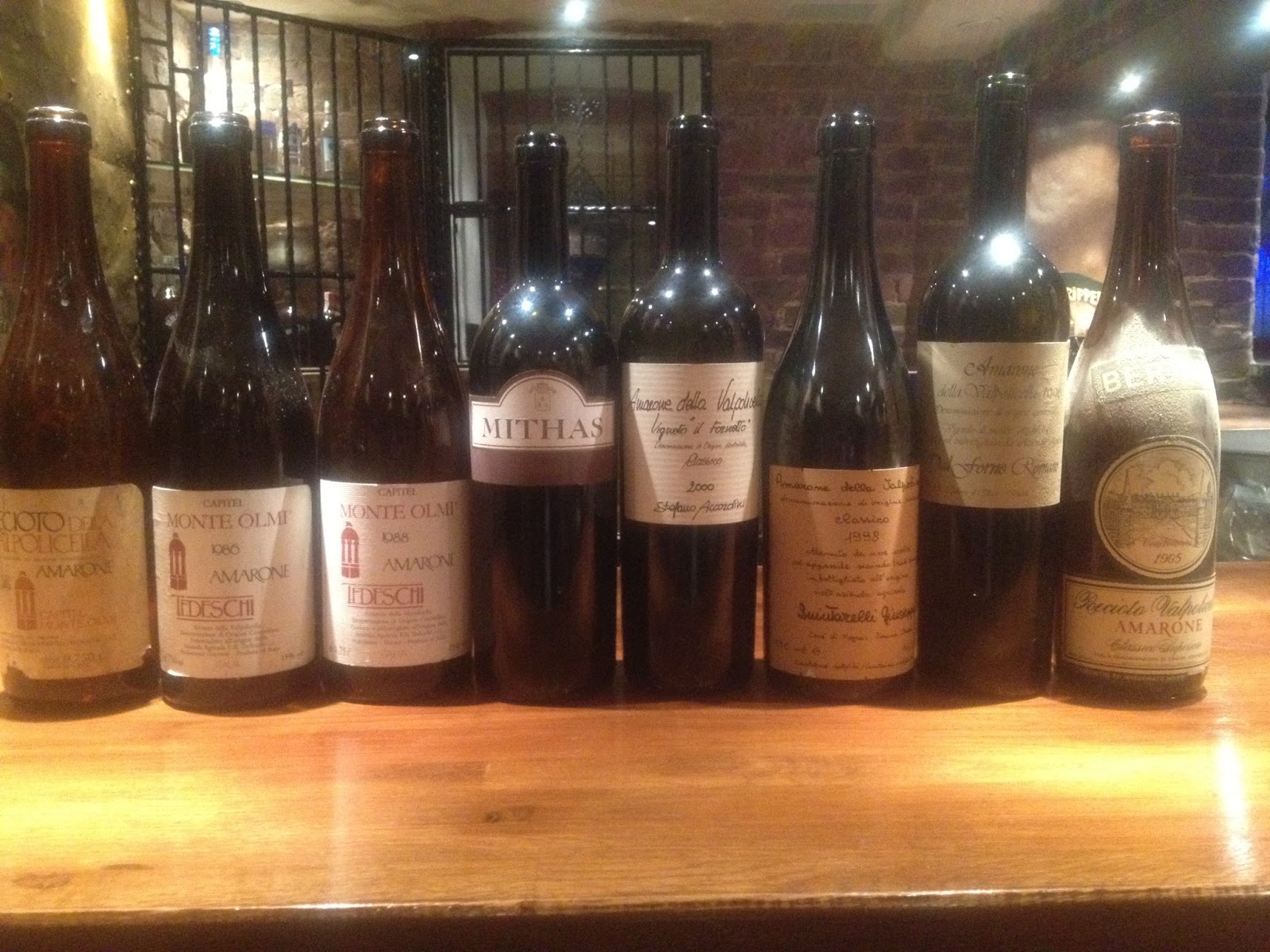
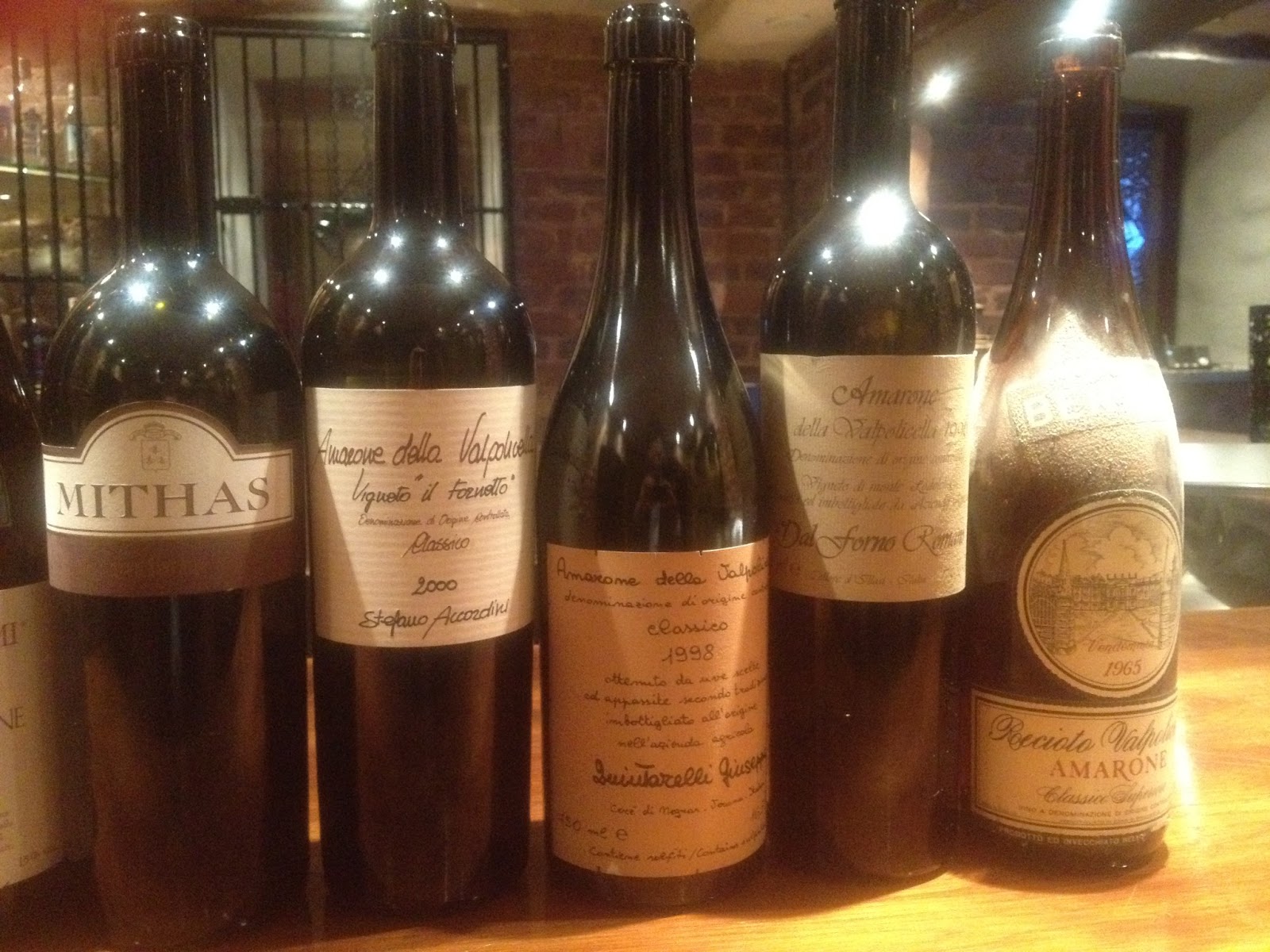
Amarone - Bertani 1965, Quintarelli 1998, Dal Forno 1996, Tedeschi Monte Olmi 1974, 1986, 1988, Corte Sant'Alda Mithas 1997, Accordini 2000


A few weeks back we had a tasting of mature amarones from Quintarelli, Dal Forno, Tedeschi, Bertani, Mithas and Accordini - producers which are household names within amarone producers.

While amarones wines can be stored for decades, most of them are drank too young i.e. only a few years after the vintage, not expressing their beauty fully to the taster. However how do they fare up when reaching their maturity? These wines were all excellent apart from one bottle. And acidity was great, offering hedonistic pleasure when combined with dried fruit emerging from the older vintages. One of the better tastings I have encountered in a few years.

The other interesting point was to find out about supremacy within Valpolicella in mature wines - while Quintarelli and Dal Forno are world famous, how do Tedeschi, Mithes and Accordini fare in a same tasting?

I will post up the Valpolicella Tour tasting notes from 2012 to accompany this text later.


Tedeschi's wines were the first flight.

Tedeschi Capitel Monte Olmi Amarone 1974


Vintage 1974 actually carried label "Recioto della Valpolicella Amarone".

A dark garnet color which was surprisingly youngish, with orange on the rim. However the orange rim was quite narrow. Not so surprisingly, notes of raisins and ripe plum on the palate with dark coffee, dark chocolate, black pepper & dark spices. Fruit has nicely dried up here (not entirely!) to give flavours of a christmas cake. Round and broad mouthfeel with minerality and limestone emerging after air time in glass. A beautiful expression of mature amarone, with a medium length in aftertaste (i.e. not short, however not the longest either).

Tannins are still there underneath there while the level of alcohol also warms the mouth. To add to the equation, the level of acidity is really good too. As those are the key components for helping wine to preserve, no wonder it has survived almost four decades.

Drink now. In addition, after getting air for 2.5 hours the wine was going down as notes of used band-aid surfaced. The wine is so mature that it does not need oxygen to open up and it is detrimental to expose it to a too long period of air contact. I would recommend drinking the wine within 1-2 hours after opening.

Tedeschi Capitel Monte Olmi Amarone 1986

The color is still garnet however showing signs of more maturity with more orange in it than in the 1974. The wine was not in perfect shape, the fruit is more in the background and the wine is more greenish, having notes of fresh sprig (or needles) of coniferous tree, mixed with dark chocolate, plum and dark roasted coffee flavors. Acidity is good too. All signs are that this was a nice wine when young however our bottle had not completely survived to this date. Recommendation is to drink Monte Olmi 1986 now and not wait longer.

Tedeschi Capitel Monte Olmi Amarone 1988

A really good wine, especially if you like intensive fruitiness. This is in great balance now. Beautiful garnet color and again a small orange rim, not that different from 1974. Like the older vintage, this one has the raisins however coupled with medicine herbs (the distinctive amarone feeling) and mocha in a full-bodied package. I wrote "really good stuff here" in my notes. Like in 1974, alcohol (15% abv) burns a little straight after opening, however when exposed to air, the wine rounds up. Intensive fruit, almost syrup like, leaving a feeling of a thick layer on the tongue remaining for minute after tasting the wine.

The wine is really well in balance now with good acidity to support it. I had it in a glass for almost 4 hours and the wine was still in good condition, so no need to hurry with it. Drink now or wait for a couple of years, if not a decade. If I would give points to a wine in my blog, which I usually don't do, this would get a 94.

I really like the tannin structure of Tedeschi's young wines produces in the recent years, however the level of acidity in Capitel Monte Olmi amarones was excellent for all three wines.

Corte Sant'Alda Mithas Amarone 1997 

Mithas Corte Sant'Alda 1997 was initially slightly reserved and closed. This one needs at least two hours of air in glass and decanting before. Patience really pays off here - if you drink the wine before it has had extensive breathing time, it seems the wine is in a sleeping mode at this point, however waiting to open up in a beautiful state in  as the core is beautiful. Herbs, licorice, plums and chocolate are mixed with forest ground, greenish (not in a bad way) notes with hints of cherries, which emerge after being open for 2+ hours. Plenty of fruit in this one, and my overall feeling is that Mithas has produced a quality wine however slightly closed at this point, and it would be interesting to try it again in a few years' time if it is more open as I do not think we saw the vineyard's true potential with this bottle.

Note to myself - try this again.


Stefano Accordini Amarone della Valpolicella Classico Vigneto "Il Fornetto" 2000

Another great expression of amarone, Accordini's Vigneto Il Fornetto 2000 had 12 years of age and the wine has decades ahead for providing hedonistic pleasure to the lucky ones having this one in their cellar.

The wine is in a really good balance. A beautiful, round mouth feel. Dark elements emerge from the glass in an intensive nose of maraschino cherries and plums mixed with dark cherry chocolate and herbs while notes of black tea raise give a dimension not present in the earlier wines in this tasting. Also some mushroom like notes emerge after 2 hours. Cherry liqueur comes in mind since there is a lot of alcohol in this one, however the wine still manages a balance as other components, including acidity, are big too and tannins are nicely integrated. The notes found here give feeling of a multidimensional wine which stands out among amarones.  Lots of sediment in the bottle. Still alive after 3 hours in the glass. Drink now or keep in cellar for decades. Should I give points? No, I give a range, which is 94-95.

Quintarelli Amarone della Valpolicella Classico 1998

We tasted Quintarelli's Amarone 1998 alongside Dal Forno's Amarone 1996, and overall feeling is that however big wine the Quintarelli amarone was, it is still somewhat lighter yet in a delicate way than the super-bodied Dal Forno.

A truly outstanding wine. The color is ruby, the wine is still looking quite youngish while having over 14 years of age. Tannins are evident and make the wine last for decades and decades. The fruit is beautiful here - ripe and big, yet delicate. The ripe fruit makes this wine feel more sweet on the palate than what its nose indicates prior to tasting it. Notes of licorice, toffee and milk chocolate as opposing to more dark chocolate in the earlier wines. Oak and smoke. Some lingonberries too, in the feeling of acidity which is great. The greenish notes of herbs often associated with amarone wines are more in form of leafy greenish notes here. Other tasters also commented on burned sugar and balsamico.

Dal Forno Amarone Della Valpolicella 1996

The most full-bodied wine in the tasting, Dal Forno's Amarone 1996 is a dark ruby, meaty, dark, super thick expression of amarone with super ripe fruit, big tannins and a smoky, almost barbecue like, feeling. This is like candy made with mixing tar flavor in it. The mouth feel is unbelievably round even with big tannins and alcohol. Really good balance and acidity here. Plums dominate the big, big extraction of fruit. The other tasters expressed the green feeling in this wine showing in the form of dill. 

This wine is sure to please most people, however it also gives a contrast to Quintarelli's delicate 1998 - the question which one is better is like ying and yang balancing - to taste them both at the same time gives you the opportunity to weigh on them and get a more thorough picture of the wines differences. The overall result of the voting in our tasting was Quintarelli's 1998 slightly edging Dal Forno's 1996. 

Bertani Amarone 1965

Slightly sweet ripe fruit is still evident in Bertani's 1965 Amarone, i.e. the fruit has not dried up entirely. The wine was really beautiful although showing signs of decline already. Almond, slightly oxidized nose with burned sugar have changed the nose to a liqueur like feeling. Drink it within an hour since it does not last long in the glass. Still it is very interesting and has great acidity.

Bertani is one of the original makers of "dry" amarone, starting in 1950s. It would be great to find these older vintages as this wine gave promise to the quality and longevity of Bertani's wines. 

Jan 15, 2013

Consumers and wine - fresh information from 2012 monopoly sales

The Finnish wine monopoly Alko has just released its most recent sales information on 2012 wine consumption and it is time to take a fresh look at what Finns, a Nordic nation of 5.4 million, are drinking.

Wines in the price range of under 8 euros per bottle continue to dominate the market with a 65 % and 77% share of all red and white wines sold, respectively, down from 68 % and 81% in 2011 (all prices being scaled to the usual 0.75 litre bottle size). The statistic is very much influenced by tax increase in 2012 as well as sales of bag-in-box wines (BiB) which represent 39% of all wines sold in Finland,  mostly priced under 8 euros.

Picture: Alko
It is encouraging to learn that wine continued growing as % of total alcohol consumption in 2012. And bulk wines naturally lead this trend as newbies to wine and new generations are more and more willing to try wine and make their initiations on the entry level products, i.e. the lower priced wines.

So why not study this trend and enjoy popular wines from the named price range, i.e. "St. Elmo Village", a Californian medium dry (12% abv) which was the 4th most popular white wine sold in 2012, and a red "Caballo de Mendoza" from Argentina's largest wine producing area (13% abv), on the 5th place among reds. 

Both wines are imported by Altia Denmark where the wines were also bottled, then further sold in Finland by Altia. The decision to bottle bulk wines in Europe rather than in the country of origin leads to a significantly more efficient logistical operation, leading to cost efficiency as well as being environmental friendly, factors which usually go unnoticed however are appreciated by the consumer if they were aware of them. The wine labels do not carry vintage information.

Picture: Alko
* ...While writing this, notes of grapefruit and flowers emerge from the St. Elmo Village, combined with a surprisingly round mouth-feel and nice acidity in the medium-dry finish. While St. Elmo Village is suited to be enjoyed with food as well as over a social setting, the red Caballo we had with minced meat soup at dinner was well suited to the carefully spiced dish. Notes of blackberry and ripe cherry in a fruity, smoky and spicy charcoal-made-barbecue style emerge after the bottle has been open for 2 hours *


... Back to the subject. Now consider this anomaly which would definitely not exist in a free market situation for wines. While wines over 17 eur in Alko represent only 1.5% and 0.5% of all sold red and white wines, respectively, the wine monopoly carried a whopping 826 and 323 items for these categories in 2012. Now compare those numbers with 285 and 217 items for wines under 8 euros, respectively. Needless to say, if there was no wine monopoly, Alko simply could not carry this amount of non-moving goods on its lists, as it is on a business sense plainly unrealistic. For those offering critique on wine monopolies, in this sense, Alko does a nice job in keeping available nation-wide a large number of extremely slow-moving wines, four times the amount of items compared to best seller wines. 

Similar information can be found from Swedish wine monopoly Systembolaget's statistics, however with a significantly larger spread among price groups. Wines under 8 eur (69 SEK) represent only 42% of wines sold while 78% of all wines are priced under the next threshold,  under 10 eur. Explaining the significant difference between the two Nordic countries, in Sweden the more pricey old world producers Italy and Sout Africa are the largest countries of origin while Chile dominates the Finnish market being twice the size of the next largest country, Spain. 


Jan 11, 2013

2000 Chanson Meursault Boucheres 1er Cru, 2002 Daniel Moine-Hudelot Chambolle--Musigny 1er Cru


Ok so here is the deal.

Burgundy from early this millenium, i.e. white from 2000 and red from 2002, both from very good vintages for the respective areas. Expectations are high. However only one delivers. Which one?

2000 Meursault Boucheres 1er Cru, Chanson

Nice golden semi-intensive color, indicating promise of a mature white. Nose has some grassy notes, like straw and seaweed, with honey, citrus and white pepper. Initially the honey is in the forefront, then pineapple and ripe citrus come in forefront. Not an intensive bouquet in this one, albeit being spicy. And on the palate, oak is fortunately not too evident, however has contributed for the wine's mouth feel being thicker, somewhat oily and round, spiced up with some nice acidity. But that's what you can expect from the wine making style, appellation and its age. Feels like this is a sensitive expression of a Meursault, one in which I would like to find more intensity in taste. On the palate, this one leaved me somewhat short. I have had many better white burgundies before.

2002 Chambolle-Musigny 1er Cru, Daniel Moine-Hudelot

Now we are talking. What a wine. Really nice structure and all that pinosity I love. Straight after opening the bottle, the wine is very concentrated and long, the taste lasting for a minute. However still so silky. Balanced nose of pepper, blueberry and lingonberry, those forest-like notes along with underbrush. Such an  impressive wine.  Like my friend said well, there is a fine element of saltiness or sea salt in this one, which I think makes it unique within Burgundy wines. Round however having a nice backbone to it, the wine commands respect. This one is meaty after 2 hours of air time. Lingonberry and blueberry mixed with meaty notes and peppery, without being too meat-soup-like, if you know what I mean.

Slightly matured color. The wine evolves in the glass after two hours after opening into an even more ripe feeling, air does good for this one (like you would be surprised of the fact...). On the palate, first you have a silky feeling, in mid-palate the alcohol gives the wine a strong backbone and the intensity of the aftertaste is great, lasting looooooong. Very long indeed.

Certainly one of the better Burgundy wines I have had for a while. Complex. The wine can be kept for many years in the cellar however it is very enjoyable right now. Usually Chambolle-Musignys are feminine in style, however this 2002 has more to it than just sensitiveness, it has a definitive backbone which does not overrun any sensitive parts.

I bought the bottle from the producer's shop in center of Nuits-St.-Georges. Got to get more of this! The producer is a small one, and has been purchased in 2008 by Domaine de la Pousse d'Or. When this bottle was made, the mayor of Chambolle-Musigny still owned the estate. It would be very interesting to find if there are differences in wine making style after the acquisition. They also ow parcel of the very prestigious 1er Cru wineyard of "les Amoureuses" in Chambolle-Musigny, a vineyard which wines are priced at Grand Cru level everywhere. Hopefully I will find bottles to buy.

Jan 10, 2013

1967 Delas Chatauneauf-du-Pape


What an interesting fella this 1967 Delas is.

Try to imagine a wine, one that has been touched by oxygen, but not too much. Plenty of oxidation in this one, just enough for the wine to enter a state resembling the taste of a dry sherry.

Notes of black tea, raisins, smoke and cigar box in it, along with strawberry juice and burned sugar, in a thick mouth feel. Medium length. Some pepper notes too, presumably from the Shiraz content in it. Like spicy meat soup. Tannins are fully integrated at this point. The wine still has great acidity.

We drank this just before Christmas, thus the season could not have been better considering the raisins tasted in this wine. A bit of orange emerges on the palate after letting it breath for 1.5 hours.

Brown color with a hint of red left, check out the bottom photo on the right. I did remember to take a photo when there was a few drops left, ok better late than never.

The wine is 20 years past its peak, however not dead and still enjoyable if old wines suit your palate. Due to oxidation, plenty of sherry feeling in this one. Which is certainly not surprising. It is nice that the wine has lived this long. However the friends I drank it with did not like it that much, the oxidation feeling taking a center stage in our conversation. So again, you are able to find good conversations about wine around this one. Interesting.

Jan 9, 2013

2011 Amauta I - A red from Cafayette Valley with a lot of personality, whether you like it or not...


It is safe to say that Amauta I divides opinions - loved by most, not understood by some. While the wine is enjoyable (or very enjoyable) to a vast amount of consumers, I know there is a large amount of wine lovers who oppose this kind of wine style. As the division in opinion will most certainly be huge, which group do you belong to?


Let's get to the basics. Amauta I is a dry red from winery El Porvenir de los Andes in a less known wine producing area of Cafayette Valley. The valley is one of Argentina's most northwestern wine producing areas. Located within the area of Calchaqui Valleys at altitudes beginning from 1,700 meters up to 2800 meters, Cafayette Valley has 2,500 hectars of wineyards for mostly the white tórrontes variety which is the most popular white in Argentina. One of the most highest altitude wine producing areas has very little rainfall, low humidity and large difference between day and night temperatures.

However also interesting red wine projects seem to pop out of the mostly sandy soils of this area.

One such is the Amauta I in my glass. Made of Malbec 60%, Cabernet Sauvignon 20% and Syrah 10% from vineyards located at altitude of 1,750 meters. The divider of many opinions.

Super intensive. This 2011 wine is very young - however even with its big tannins, the sweet tannin structure makes the wine enjoyable already at a young age. The producer explains impact of high altitude of their vineyards to give sweet tannins to their wines. Some of that toffee feeling to reveal that French oak was (I think partially) used. So let's give a positive remark on tannin structure. After tasting the wine, I was very surprised to learn that the wine had been matured only 6 months in oak. Seems like there was much more oak in this one.

Its unbelieveable big sweet fruit will please a lot of people. Nose with loads of smoke and roasted meat, oak, sweet cola, herbs and very strong licorice and toffee integrated to plum and blackcurrant. The palate is dominated by almost-sweet fruit which is the tale of this wine. After getting air for 1.5 hours, the notes of meatiness in the wine turned into a charcoal (barbecue) feeling. And that's your recommended food pairing too.

A lot of alcohol in this one, 14.5% abv. I can already feel wine aficionados who love their Pinot Noir trembling. OK, so we have established that this wine is super intensive.

However...

Where is its sensitivity? Where is the hint of something you want from the wine to seduce you?

You are not able to find it in this wine. This one is a muscular, strong, fruit & licorice bomb which is in-your-face in style. Not my type of wine, however if you need a big wine, look no further. Price tag is set at 24 eur in your local Alko shop, so the price keeps its sales numbers relatively low.

At first when opening the bottle, the wine has a bit of a harsh aftertaste after 5 seconds, of which volume decreases as time in glass increases. But it stays there underneath in the mouth feel while the wine rounds up with 1.5 hours after opening.

The positive fact about this wine is its ability to provoke discussion. While enjoying the bottle we had plenty of discussion about it, which is a compliment to any production with lots of winemaker's love behind it.

The story behind El Porvenir de los Andes are Italian immigrants who established the winery in 1890. The winery was however bought by Romero-Marcuzzi family in 1999 who invested in wine making and the winery now lives a renaissance. The renowned wine maker Paul Hobbs is consulting the estate.

Sep 29, 2012

Burgundy Harvest Blog 5 - September 28 - Finally sunshine after all that rain

Finally sunshine after all that rain. It has been a very rainy harvest season in Burgundy. Honestly you could say that we had not seen a cloud which did not rain on us for the last five days until yesterday.bIn Gevrey-Chambertin, it has rained in all of the last five days except today which is a remarkable difference to last years harvest where it rained in only one day.

Only light rain showers yesterday though when we harvested Chambertin-Clos de Beze grand cru. The grapes were good with only limited selection in the vineyards was needed. In each of the grand crus harvested thus far, the quality and health of the grapes is higher than in village appellations, which in addition to the terroir aspect speaks for the higher market price of the products. The raw material is just better. 

However the real story of the day is the quality of Drouhin-Laroze's grapes for the entry level Bourgogne red. The grapes used in the wine were in such good health that people in the winery were astounded with the quality, which rivaled that of grapes from grand cru vineyards. The domaine's 2012 Bourgogne red should be kept in mind when released.

Today it was beautiful sunshine the whole day. Also part of yesterday when Clos de Beze was harvested. Tomorrow we will harvest the last remaining grand cru, Latricieres-Chambertin and the premier cru of Lavaut St. Jacques which is among the coldest premier crus in Gevrey-Chambertin and thus usually harvested among the last vineyards harvested in the appellation, for allowing grapes to mature the longest. 

Tomorrow is the last day of harvest and the harvest-ending party with the team. This years harvest was 10 days. 

Sep 24, 2012

Burgundy Harvest Blog 4 - September 24


Another rainy morning in Gevrey-Chambertin turned into a sunny afternoon. Our work was done before lunch though as we decided to harvest white grapes for domaine's other, negotiant wines.

To recap the harvest thus far, we started with harvesting grand crus in Chambolle-Musigny (Le Musigny, Bonnes Mares) and part of village appellations during the first days. The original plan was to harvest all grand crus first as grapes had matured so well. However the plan was changed to harvest village as rain set in during the third day and forecasts seemed to deliver more rain in the next days. The fourth day was sunny and we harvested premier crus. The fifth, today, was again rainy in the morning so chardonnay was harvested and pressed. The pressing of white grapes cut the capacity of the winery and pickers were given rest if day off as no red grapes could have been processed in the afternoon. Pinot noir is again harvested tomorrow. Grand crus within the Gevrey-Chambertin village area, Chambertin Clos de Beze, Latricieres-Chambertin and Chapelle-Chambertin are still to harvest.

Burgundy Harvest Report 3 - September 23

Welcome to the best upper and lower back training session in the world, grape harvest in Burgundy. Not only do you get in great physical condition working here for 1.5 weeks, you do the exercise in the most outstanding of surroundings, in (or looking over) grand cru vineyards in Cote de Nuits.

On the vineyard you work either as cutter or a carrier. If you are a cutter, your job is to select only good grapes to your 6kg basket, i.e. cutting out the bad ones from the grape bunches to be sent to the winery. Basically you are constantly bending your lower back, kneeling down or sitting in a squat position for 8 hours each day. Needless to say, it is especially strenuous on your lower back.

If you would like to exercise your upper back, then be a carrier. As a carrier, you carry a basket holder on your back which is  specifically designed for this purpose, weighing some 5 kg empty. And your basket is filled every 4 minutes by 4 or 5 cutters, each throwing you 5-6 kilos of grapes (total 23 kg) which you then walk from the vineyard to the road where the tractor waits, i.e. on average 150m. So you either walk with 5 kg or 28 kg on your back for 8 hours a day. I can personally guarantee you this is a much better workout than your average gym workout.

Drouhin-Laroze places great emphasis on gentle handling of grapes at the harvest before destemming. Using only small 23 kg baskets, grapes are not kept under significant weight, i.e. they are not crushed already in the vineyard unlike in larger baskets used by certain other producers. If grapes are placed under too heavy weight and are crushed, there is a risk that yeasts and micribes on top of grape skin begin to react with grape juice, allowing fermentation to begin too early and not in a controlled environment. Intact grapes where grape juice is kept within the skins allows the wine maker to control the process and eliminate unwanted chemical reactions which might lead to unwanted off-flavours in the wine.

No rain after yesterday morning. Grapes were dry and the sun came out in the afternoon after a cloudy morning. We continued with Village wines in the morning while Premier crus were picked in the afternoon. Better quality in the premier crus. Drouhin-Laroze owns vines among Gevrey-Chanbertin's premier cru sites of the Craipillot, Au Closeau, Clos Prieur and Lavaut St. Jacques (most other domains write that Lavaux St, Jacques by the way).

Tomorrow we will collect white grapes for the Drouhin family's daughter Caroline's negotiant wines. It will only be a half day tomorrow, we will work only until lunch.

Sep 22, 2012

Burgundy 2012 harvest blog 2, September 22

Greetings from the very, very muddy Burgundy.

It rained almost whole night and the rain stopped just before start of harvesting in the morning. Thus the day was a very muddy one to say the least, earth getting stuck to the legs of the rain coat clad bunch of pickers today. The rain water on top of grape bunches had not had time to dry before picking, so we decided to continue with village appellations of Morey St. Denis and Gevrey-Chambertin. Part of Gevrey-Chambertin village apellation was harvested also on Thursday, the first harvest day. We will most probably continue harvesting Grand Cru vineyards tomorrow as it has not rained a drop since 7.45 this morning and grapes have enough time to dry before work continues early Sunday morning.

Again today's grapes were in such good condition, healthy bunches which were relatively easy to pick up, with less problems with mildew for pickers than in 2011.

Good early reports from Piemonte, Italy,  too as a friend of mine harvested his barbera grapes simultaneously near Barbaresco and was very happy with the quality of the grapes there.

Early morning yet again tomorrow as the domaine wants to collect as much as possible before the next rains are forecasted to reach the area, which is most likely on Monday. So Monday will be a shorter day for us with half a day off.

Sep 21, 2012

Burgundy harvest 2012 blog 1, September 21

It is a very special time of the year, start of wine harvest in Burgundy. And the Laidbacksommelier is reporting to you from Gevrey-Chambertin again this year.

Gevrey-Chambertin is the northernmost village in Cote d Or which has Grand Cru vineyards, and her wines are widely considered as more masculin, powerful yet elegant compared to most wines in Burgundy. While Chambolle-Musigny might be the queen, Gevrey could be the king.

In Gevrey-Chambertin, harvest started on September 20th in perfect conditions and early reports from the vintage are promising. The few weeks leading to the third week of September were favoutable for grape ripening and Grand Crus are picked at optimum ripeness. Further,  this vintage is characterised by lower yields however with higher grape quality. Last year Grand Crus were harvested the last howeverr this year it is first Granc Cru then the other appellations. In 2011 we had to leave Grand Crus in the vines last  as their grapes were allowed time to fully ripen. This year ripening is not an issue.  

In the morning of September 21st, the sun shined from a clear sky as we harvested Grand Crus of Clos de Vougeot and Bonnes Mares. Musigny was harvested already on September 20th. Grapes in Clos de Vougeot were, like in 2011, very healthy indeed and so easy to pick up, almost none selection of grapes had to be done in the vineyard. You are able to taste a round silkyness from the grapes themselves, it is very exciting to see what the actual wind will be like when released. Domaine Drouhin-Laroze owns 36 rows in the higher part of the Clos de Vougeot grand cru vineyard which is regarded as more prestigious than the lower part of the vineyard. 

After finishing Clos de Vougeot, we headed to Bonnes Mares, the legendary grand cru vineyard which lies on both sides of the border of villages Chambolle-Musigny and Morey St. Denis. The lower part of Bonnes Mares, representing majority of the vineyard,  has significantly smaller size of grspe bunch than usual in Burgundy vineyards, also offering a striking difference to average bunch size in Clos de Vougeot. The upper part of the vineyard includes unhealthy grapes and nearly half of grapes are cut down to preserve quality. 

The above phenomenon implies a meaningful commercial view point to making wine. When grapes are healthy, it is kids' play to perform the harvest. However when grapes are not in perfect condition, it takes considerably more time to do meticulous selection of only good grapes in the vineyard, thus taking more time, labour hours and more qualified grape pickers than on a good year, costing more money. So not only you are able to charge a premium.price from wines of a good vintage, your labour costs are likely to be lower too. 

Time to get a good rest before tomorrows challenges. Rain surprised us during the last half an hour of harvest today, and it has been raining the whole evening so tomorrow will be very wet conditions on the vineyard. 

Peace and out 

From Burgundy with love,

The Laidbacksommelier

Sep 20, 2012

Off to Burgundy for harvest 2012... Texts from Summer Tour of Valpolicella to come... and much more

Wow,

August and September have been very busy for yours truly, and there is a large backlog of wine blog texts awaiting to be published. Tasting notes from the Valpolicella Tour in summer, Josko Gravner's and Miani's wines, vintage Brunellos, Comte de Vogue white Musigny, Dolcettos and Barolos from 1970-1980s, vintage Bordeaux from 1970s to 1980s, and many others.

And now it will get even busier, as I head to Gevrey Chambertin in Burgundy for 9 days of grape harvest at Domaine Drouhin-Laroze. Another great chance to learn wine making, how to operate a winery and vineyards first-hand. I will certainly try to post texts to my blog from the harvest work.

More to come!

Aug 8, 2012

Kendermanns Grauburgunder Trocken 2011 (Pfalz, Germany) - pretty value for small money


During my trip to Berlin this July I tasted a local wine worth a note when thinking of a reasonable everyday wine with multiple food pairing options.

Kendermanns Grauburgunder Trocken 2011, 12.5% abv, 7.9 g/l residual sugar.

The wine is from the Pfalz region in Germany which is the second largest wine producing area in Germany after Rheinhessen, predominantly a white wine area.

Winemaker Philip Maurer made this grauburgunder (i.e Pinot Gris) a good value wine which in particular could be combined with plenty of dishes. There are cinnamon and apple notes on the nose, mixed with earthy / dusty cellar like notes which however do not disturb at all.

Just enough residual sugar to give a round mouth feel, however balanced by enough acidity for the palate not to feel sweet. Medium bodied. Almost oily composure and nicely balanced albeit feeling of a higher than usual alcohol content. Apple, pear and white pepper on the palate.

Noticeable alcohol gives structure to the wine and is typical of pinot gris / grauburgunder grape which usually ripens fast, leading to higher sugar content and therefore higher potential alcohol content. However here the winemaker has left some residual sugar in the wine and limited alcohol content to increase only to 12.5%. Alcohol is still slightly overpowering when the wine warms up, so drink yours well chilled.

The wine can be used with multiple dishes due to the round feeling, and goes especially well with spicy dishes. Try it with thai food or similar dishes. A nice wine for the price (the bottle cost only some 5-6 euro in Berlin).

P.S.... The finish is, though, quite short initially and slightly flirting with bitterness with only short glass time. However it evolved into a more round wine with more glass time. Some citrus Hubba Bubba (chewing gum) notes emerging after the bottle had been opened for 2 hours.

Jul 10, 2012

2010 Clemensbusch Riesling (Mosel)

Summertime in Berlin. Riesling please! The mind flow of a wine lover captured in two sentences when visiting Germany, with their outstanding quality in Riesling production. I bought this 2010 Riesling from Karstadt at Kurfurstendamm. Another good wine store is the Galeria Kaufhof department store which has a massive wine department of local and foreign wines, a must-visit every time in Berlin.

Clemensbusch Riesling seems to be a one-off among 2010 Rieslings, as it offers subtle fruit with low acidity compared to most local Rieslings from the vintage. The style is more of a balanced ripe fruit style - Rieslings acidity is always there, however this wine lives on other merits than plain crispness - it has style to accompany the acidity. Ripe grapefruit, melon, flower notes and white pepper offered in a smoky style, as well as beautiful minerality on the nose.

Taste is beautifully balanced with ripe grapefruit and minerality which are in working in unison with Rieslings trademark high acidity. The wine is almost oily on the tongue, which is surprising of such a young Riesling and for an entry level product of a wine producer. The oiliness brings a nice component to the wine. Serious wine making here. Constructive criticism on the finish which is quite short.

This wine being only their entry level riesling, it would be interesting to try Clemensbusch's range of wines. Mental note on a to-do.

Jul 2, 2012

2008 Keo Heritage (100% Maratheftiko) from Cyprus - an interesting wine where Bordeaux meets Syrah

From a rare Cypriot indegineous grape Maratheftiko (100%), Keo's Heritage wine is part of a serious effort to re-establish quality wine making in Cyprus.

Keo has been in the forefront of the development to bring back indigenous grapes cultivated on the island since ancient times, of which Maratheftiko is a prime example. As the grape is found only from the areas of Pitsillia and Troodos the scarcity of the grapes leads to a production quantity of only 10,000 bottles.

I consider myself lucky that a friend of mine brought the bottle from Cyprus to show the capability of local wine making. The Heritage 2008 is an interesting wine which combines aromas of a bordeaux blend and a northern Rhone syrah. The 2008's palate is soft, round and almost silky and with nice acidity. Full-bodied with a grip on the mid-palate however with a slightly bitter and short finish. Aged for 3 years in French oak from Limousin, the wine's tannins are nicely integated at the age of 4 years (tasted in July 2012).

A world of aromas. Full of ripe plum as well as mint, tobacco, moccha, hint of blackcurrant leaf, chocolate, dark spices, ink and green pepper, all indications of a classical bordeaux blend of Cabernet franc, Merlot and Cabernet Sauvignon (in that order, due to noteable green notes). However after longer decanting the aforementioned notes are mixed with pepper, blueberry and leather, all Syrah-like notes.

An impressive wine (albeit the short finish) from a relatively unknown grape. It would be highly interesting to see what other producers are able to do with this grape, as the grape itself shows potential. The wine was recommended to be enjoyed from cabernet / bordeaux glasses, which we experimented to be a good option.

Having previously tasted Vlassides' Cabernet Sauvignon (a surprisingly good wine), I come to think that Cyprus is a hidden gem in particular when considering price to quality ratio. And with only limited area for cultivation of wine, Cyprus might stay under the radar for a while. However based on tasting wines from limited amount of quality producers such as Keo and Vlassides, quality wine making looks promising on the island. I want more of these!

Jun 21, 2012

1960s - 1980s Barolo tasting + 1995 Ferrari Perle


Mature barolo


Having participated in several tastings of mature nebbiolos lately, below is a short description what to expect from nebbiolo turned adult, and the multitude of nuances one can get from wines which have aged beautifully.

Tasting notes are from an interesting line-up of 1960s to 1980s barolos collected from Italy. Mature barolos and other wines made from nebbiolo grape (like Spanna, Carema, Gattinara) offer excellent price to quality ratio. Luckily the price inflation experienced in top bordeaux and burgundy wines has not reached these Piemonte's jewels yet - and wine enthusiasts hope it won't for a while.

The tasting included really well aged wines and 1964 Giovanni Manzone, 1978 Montanello and 1982 Fenocchio stole the show being truly adoreable wines.

1978 Moscone Barolo

Color of a ruby jewel. Loads of sediment in this one, as in other wines in the tasting. Moscone's Barolo 1978 has an austere personality, however the grip from big tannins and acidity in the aftertaste bring you back on earth. A bit oxidized however could be expected from a barolo of this age. Nose has mature nebbiolo trademark burned rubber feeling with cherry tree / black cherry and cranberry notes in an almond liqueur / cherry liquour like package. Notes of black tea in nose which is personally really enticing to find in a wine. A peppery feeling in aftertaste too.

However the wine was not the winner in this tasting as the nicely dried fruit was left behind in intensity to other wines tasted during the evening.

1978 Montanello Barolo (Castiglione Falleto)

The color is amazingly still a youngish medium intensive ruby, however flirting with brownish with an orange hue. The wine is also in other respects youngish, not showing signs of being tired at all. This is a fresher version of mature barolo with really nice acidity. A broad range of aromas in the nose: cinnamon, tea, trademark burned rubber/burned sugar as well as fermented strawberry juice, coffee, licorice and ripe plum. Mouthfeel is fresh from high acidity, pure and balanced on mid-palate turning to cranberry / lingonberry notes in the aftertaste which is strong.

Acidity carries this wine really far in aftertaste. With air the wine develops in the glass where ripe fruit takes a larger role than after only short decanting. A beautiful mature wine!

1982 Fenocchio Barolo (Monforte d'Alba)

Another jewel in the glass. What a wine this turned out to be! Color of a ruby jewel, the wine looks terrific in the decanter. Orange color is taking over bit by bit this wine, obviously from long maturation. From a great vintage. Full-bodied even in nose. The slightly oxidized nose is really interesting with aspargus and dill notes mixed with burned sugar and tar, herb liqueur and licorice - a lot of green notes however in a nice package. On the palate the wine is full bodied with really ripe fruit and sweet alcohol, mocha, chocolate beautiful dried fruit supported by tannins which are integrated and the aftertaste continues and continues. An excellent wine.

1974 Enrico Serafino Barolo

A perverted nose of meat gone bad (like slightly rotten) and plaster, which arise consideration of brettanomyces in this wine. Also slightly oxidized, reminding of a sweet sherry wine as in the nose there were, along with mature nebbiolo's burned sugar, also syrapy sweet fruit and truffles. Full bodied taste which develops on mid-palate into a beautiful and concentrated dried strawberry feeling. Also some orange notes on palate. However the taste does not last long and the wine's acidity is not up to par in this peer group.

It was striking to find these qualities in the wine as according to other tasters a recently tasted Serafino's barolo from late 1960s was in excellent condition and delivered in a big way.

1964 Giovanni Manzone Barolo (Monforte d'Alba)

Giovanni Manzone's 1964 barolo is one of the more aromatic and multidimensional wines in respect of nuances developed from long aging we have had in barolo tastings. There are more barolo tasting notes to be updated in my blog, however this Manzone wine is a really good one, if not great and was a favorite among the tasting crew.

Brick red color with beautiful orange developing in the sides and a watery rim. Loads of sediment. The beautiful mature wine expresses itself in multitude of ways in the nose. The bouquet is like meshing together some oxidised wine (like madeira) with notes of violet, licorice, fried sugar, sweet cranberry, apricot and "toffee & caramel", even some leather. No burned rubber here. Also some tasters noted "plum dessert cream" and "sour orange". Plenty to adore in this one. Further on the palate the wine has a nicely oxidised feeling, like in madeira wines. Dried fig, black tea and cigarbox dominate in the mouth while tannins are big and give structure, however do not attack, not anymore due to the wine being evolved.

1995 Ferrari Perlé (Fratelli Lunelli, Talento Trento D.O.C.)  

Having never tasted Ferrari's sparking wines, the 1995 Perle offered a pleasant surprise as the sparkling wine was suberb. Some say that the wines from the region are closest to Champagne compared to other sparkling wines - Ferrari Perle stood in its own class on its own merits. Made metodo classsico, i.e. champagne method, this Italian jewel has small bubbles and the attack is velvety as acidity is mellow and almost caressing. Toasty, beautiful floral notes supported by fudge / caramel and light apple notes (the wine is 100% chardonnay). Acidity is medium minus at most, however the wine is in balance with the acidity level. "Pina colada".

Jun 8, 2012

1975 Chateau du Tertre (Margaux) - Past its peak however still offers plenty of enjoyment

The 1975 Chateau du Tertre's nose offers such great aromas and promise that it was a pity to find that on the palate the wine had already seen its peak. Most of the fruit of the wine had disappeared and the absence of fruit allowed maturation components (tannin, acidity and alcohol) to dominate the palate. However how much kicks and enjoyment can you get plainly from the bouquet of a wine? Plenty I say if you consider this wine!  Based on the promise of the nose only it would be really interesting to taste the chateau's wines from late 1970s to 1980s where fruit content should still remain. If any reader has a view on the vintages which are still alive, please comment below to this blog. 

How then to describe the beautiful nose? Try to think of espresso, plums, leather, chocolate, basil, herbs, meat and smoke in a slightly oxidized package, that's what you get in du Tertre at 37 years of age. It was extraordinary. Vintage 1975 is not considered a great one, at most average in Margaux. Thus wines from du Tertre older than 1975 could still survive today, however I would recommend enjoying them soon. The 1975 should have been drunk at least 5 years ago. 

The mature color was originally ruby however turned brick red/brown in this stage with lots of orange on the sides of the glass. On the palate the wine is medium bodied and there was still plenty of acidity. The taste is quite linear i.e. follows a direct path, not many layers here. While developing considerably in the glass this is a sensitive expression of mature bordeaux, although quite lean. The wine was surprisingly good with Morbier cheese. A friend of mine bought this bottle for €30 from the Netherlands. 

May 29, 2012

Chateau Musar 2001 - drinking beautifully right now

Ladies and gentlemen,

Image from petervellawines.com
announcement on an opening of a drinking window: Chateau Musar 2001 is drinking beautifully right now. The wine has developed really well showing those developed maturation elements which entice you to open any bottles left right now - however the wine has a lot of promise for even longer maturation. And what a price - quality ratio.

What a nose. Rich and matured, full of cherry cola mixed with really ripe plum, in addition to leather and cigarbox (secondary notes from longer maturation), black pepper and some burned rubber -> giving a feeling of a mature 1970s nebbiolo. However Musar is a bordeaux blend from Bekaa Valley in Libanon and from early this millenium.

The wine is in very good balance where big tannins have almost entirely been integrated, the mouthfeel is initially silky however the strong acidity runs over the silky feeling on the mid-palate, leading to a long finish full of dark fruits and nicely mixed with the acidity of the wine. Fruit has not dried yet thus indicating potential for further, even long cellaring. The components are there - sweet alcohol, tannins and fruit content as well as the great acidity. It is a big wine, one I could enjoy almost for the rest of my life (save for some pinot noir and nebbiolo).

I am glad for the fact that I still have some left in my cellar.


May 17, 2012

1990 La Mission Haut Brion, 1998 Ornellaia, 2002 Tassanaia, 1993 Flaccianello della Pieve, 1989 Produttori del Barbaresco

A Wednesday and free from work tomorrow, so why not organize a tasting? Together with other wine enthusiasts, we gathered in a cellar in Helsinki for a treat. First, a mature bordeaux and a prized bordeaux blend from Tuscany, then off to other Italian treats.

1990 La Mission Haut Brion (Graves)


The bottle had been placed upwards and cork removed for some hours now, however the wine was still a bit murky initially. A beautiful medium intensive ruby color which was surprisingly young for a mature wine. And while the wine is already 22 years old, i.e. should be mature, the La Mission is so long-lived that the 1990 had not reached its peak yet, so think carefully if you want to open your bottle. 

Dominated by red fruits, the nose is superb with nuances of ink, minerals, herbs and some leather. The mineral  notes seems to be a trademark for Graves comparing to other bordeaux appellations. With the ink in nose, it gave you a world of blue colors mixed with red fruit should you close your eyes and just feel it. 

However the palate was initially hard and steely, fortunately developing in the glass into a really smooth and velvety wine but not being able to shed all of the steely feeling. A slightly harsh aftertaste too. A problem with the bottle? You really need to decant this wine. Loads of syrapy fruit dominated by blueberries, sweet tannins, a great amount of fruit underlying there, and notes of chocolate and mocha developing after an hour. 

Overall feeling is that it is a beautiful and maybe the most velvety wine I have ever tasted, however the steely and harsh aftertaste was somewhat disappointing. Need to try another bottle of these at some point.

Blend in 1990: 42% Cabernet Sauvignon, 48% Merlot, 10% Cabernet Franc

1998 Ornellaia (Bolgheri DOC, Tuscany)

Next up, a bordeaux blend from Tuscany, i.e. Supertuscan by Tenuta dell Ornellaia. The 1998 Ornellaia was WineSpectator's Wine of the Year in 2001 (96p). However a mixed review from Wine Advocate which gave it only 91 points. Well, we had to try and taste it ourselves.

The ruby color was more intensive than in La Mission Haut Brion. Nose was intensive with balsamico, sweet black cherries, chocolate and herbs dominating. The mouthfeel was like velvet. So smooth, the sweet cherries linger in your mouth a long time, tannins are present however nicely integrated. Palate follows the nose with licorice in the taste in addition. I will lean more to WineSpectator in this one. So did other tasters.

The blend in 1998 was 60% Cabernet Sauvignon, 35% Merlot and 5% Cabernt Franc.

1993 Flaccianello della Pieve, Fontodi (Colli della Toscana Centrale IGT) 

This is interesting. I have 2001, 2004 and 2006 Flaccianellos in my cellar, however now it is time to taste a mature Flaccianello, a 100% sangiovese IGT from the Chianti region in Tuscany. The result of the tasting: do not even think of opening the 2001-2006 vintages in long time. 
The 1993 Flaccianello was still youthful, altough had matured a bit. A medium intensive color, with some mature brownish mixed with ruby and an orange hue. 

You could really notice olives in nose, which is so prominently Tuscan - just like you are able to notice lavender in many wines coming from Provence, France. Also sangiovese's trademark cherries which had developed into an almost syrapy feeling (although the wine being totally dry red). Got to love that. 

Initially the mouthfeel was tight however opened up within over an hour. Both nose and taste got broader in the glass as time went by, the wine really needs air. 

Loads of ripe fruit underlying there. A lot of acidity too, this is like eating a cherry containing a lot of acidity. Combining these factors, the wine feels at the same time like sweet ripe fruit and totally dry at the same time, the acidity obviously taking away the sweet feeling. Acidity maintains in the mouth really long, actually longer than what fruit is left. 

Could be enjoyed now, however will absolutely get better with more cellaring (give it another 3 years). So enjoy this one at 22-25 years of age. So my 2001, 2004, 2006, see you in 20 years. 

2002 Tassanaia (Toscana IGT)

Due to a very challenging year in 2002, Castello del Terricio did not make its flagship wine, Lupicaia, while the grapes were used in this Tassanaia.

Thus the 2002 Tassanaia could be better than other vintages, albeit poorer growing conditions. The producer achieved 14% abv although the vintage was marred by poor weather. 

Already showing some age in the glass with slightly brownish and medium + intensive garnet color. The nose is full of blueberries, smoke, tobacco, spices and italian herbs. Really tannic too. Needs a lot of time for the abundant tannins to integrate, if they will ever. A really fruity tuscan, with blueberries taking the pole position in mouth accompanied by notes of plums, "cloves and pepper". 

However the aftertaste is short, indicating that fruit was not totally ripe when picking. Blame it on weather. This is a blend of 30% CabSav, 30% Merlot and 40% Sangiovese. 

1989 Produttori del Barbaresco (DOCG Barbaresco)

Medium garnet / almost brownish colour with orange hues, as in mature nebbiolo you would expect.
Some burned rubber in the nose, a trademark for mature nebbiolo too, along with tryffels, almonds, fried chestnuts and black fruit. Some slightly chemical notes there too, which however do not disturb at all.
Tannins are still big and tight in this one, and not nearly enough ripe fruit to balance it out. 13.5% abv. Some peppery feeling in mouth too.

Nose develops into licorice and burned sugar after spending over hour in the glass, increasing the enjoyment of sniffing this mature wine.